


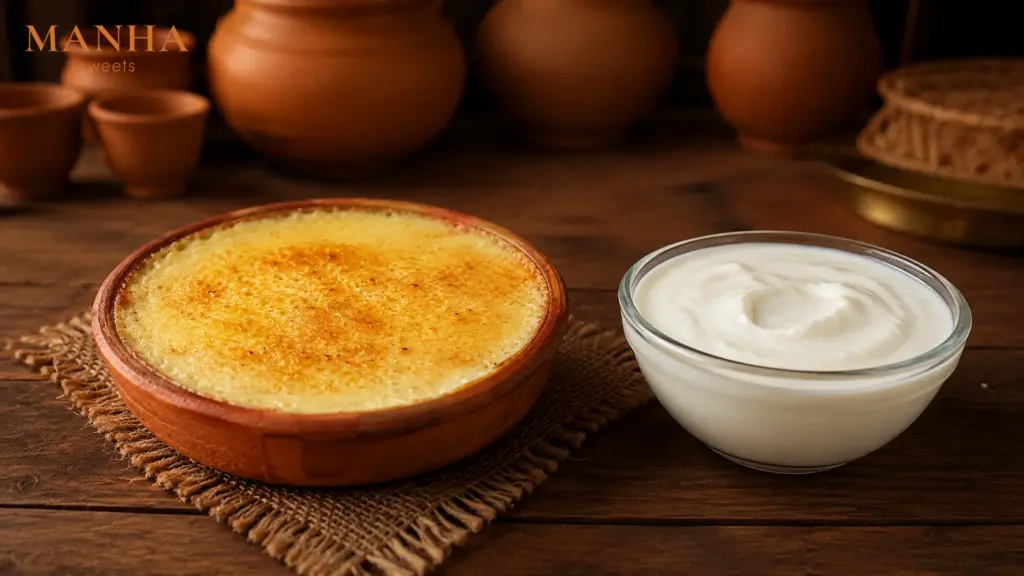
Ask anyone from Bengal to name a dessert and misti doi will come up before they finish thinking. This thick, caramel-toned sweet curd looks like yogurt, ferments like yogurt, and is served chilled like yogurt yet one spoonful tells you it belongs to another world entirely. So what actually separates misti doi from the plain yogurt in your refrigerator?
In this guide, we compare Bengali sweet curd with regular yogurt across the ingredients, the method, the vessel, and the place each one holds at the table, so you know exactly what you are tasting the next time a clay pot arrives at your door.
The short answer: misti doi is made from reduced full-fat milk that is sweetened with caramelised sugar before fermentation and set in porous clay pots, while regular yogurt is simply plain cultured milk. The result is a true dessert thicker, sweeter, and far deeper in flavour than everyday doi.
What Exactly Is Misti Doi?
In Bengali, misti means sweet and doi means yogurt, so misti doi is, quite literally, sweet yogurt. But the name undersells it. Traditional misti doi is made by slowly reducing full-fat milk, sweetening it with caramelised sugar or date jaggery, culturing it, and letting it set overnight in unglazed clay pots. The result is dense, silky, and fragrant with caramel closer to a set custard than to anything you would pour over rice. You can read more about the history of mishti doi on Wikipedia. Every region of Bengal has its own accent of the dessert, some pale and lightly sweet, others deep amber and intensely caramelised but the heart of the recipe never changes: good milk, patience, and clay.
Few places take doi as seriously as Bogura, the northern Bangladeshi district known as the doi capital of the country. Bogurar doi carries national GI (Geographical Indication) status, awarded in June 2023, and its story stretches back roughly 250 years to Ghetu Ghosh of Sherpur, the sweet-maker credited with perfecting it.
What Do We Mean by Regular Yogurt?
Regular yogurt plain doi, or tok doi as Bengalis call the tangy version is milk fermented with a live culture, and nothing more. The milk is usually not reduced, no sweetener is added, and it sets in whatever container is at hand: steel, glass, or plastic.
That simplicity is its strength. Plain yogurt is an everyday workhorse stirred into rice, whisked into lassi and borhani, spooned beside biryani as raita, or used to tenderise meat. It is refreshing, gently sour, and endlessly useful. What it is not, however, is a dessert.
5 Differences Between Misti Doi and Regular Yogurt
The two share a fermentation step and little else. Here are the five differences that matter most.
1. The milk is reduced, not just boiled
For misti doi, full-fat milk is simmered patiently until it loses a large share of its water and turns rich and slightly golden. This concentration is what gives sweet curd its dense, spoon-standing body. Regular yogurt is made from milk that is simply boiled and cooled, so it stays light and loose by comparison.
2. The sweetness is caramelised in, not stirred in
Misti doi is not yogurt with sugar on top. Sugar or date jaggery is caramelised and blended into the warm milk before the culture is added, so the sweetness and the caramel notes ferment together with the milk. This is why authentic misti doi has that unmistakable reddish-brown colour and toasted flavour that no amount of sugar stirred into plain yogurt can imitate.
3. The clay pot does real work
Traditional misti doi is always set in unglazed terracotta. The porous clay quietly wicks away extra moisture while the curd sets, thickening the texture, and lends a soft earthy aroma. Regular yogurt sets in non-porous containers, which hold all the water in.
4. The fermentation is slower and warmer
Sweet curd sets low and slow — traditionally overnight — giving the culture time to work through the thick, sweetened milk. Plain yogurt is a quicker, lighter set. That patience shows up in the final texture: good misti doi is firm enough to hold its shape proudly on a spoon.
5. One is a staple; the other is a celebration
Plain doi belongs to the everyday table. Misti doi belongs to occasions: weddings, Eid trays, Puja bhog, good exam results, and the simple joy of a guest arriving. In Bengal, ending a feast without doi feels like a story without an ending. That is also why a clay pot of misti doi is among the most common gifts carried when visiting relatives — it says celebration without needing a card.
How We Make Misti Doi at Manha Sweets
At Manha Sweets, our karigars craftsmen with more than 30 years of experience make doi the way Bogura has always made it. Pure full-fat milk from local Bogura cows is reduced in brass cauldrons over a wood fire, which caramelises the milk and sugar gently and evenly. The wood fire matters more than it may seem: it heats the brass slowly, letting the milk take on colour and depth without ever scorching, a rhythm our karigars read by eye and aroma, not by timers.

The cultured milk is then poured into unglazed clay pots and left to set naturally. No preservatives, no shortcuts — every pot is made fresh daily. You can see our classic misti doi here, or explore the full shahi doi collection for our richest, creamiest pots.
Which One Should You Choose?
Honestly both, for different moments. Keep plain yogurt for meals: raita, lassi, marinades, and everyday cooking. Reach for misti doi when the moment calls for something more: dessert after dinner, a gift for the in-laws, a festival table, or a homesick craving for Bengal.

If you are new to sweet curd, start with a classic clay-pot misti doi, then try the shahi glass doi for a richer, single-serve treat. You can browse everything we make on our products page and yes, we deliver across Bangladesh. For festivals and family occasions, many customers pair a large pot of doi with a box of roshgolla or rasmalai for a complete Bengali dessert spread.
How to Serve Misti Doi Like a Bengali Host
Misti doi needs no dressing up, but a little care in serving lifts it from lovely to unforgettable. Always serve it chilled, and always in its clay pot if you can. The pot keeps the curd cool at the table and makes a beautiful, rustic centrepiece. Scoop gently from the top rather than stirring; vigorous mixing breaks the delicate set that took a whole night to form.
For individual servings, spoon the doi into small earthen bowls or kulhads and finish with a pinch of crushed pistachios or almonds. Some families in Bengal enjoy doi with chira flattened rice as a cooling breakfast, while others save it as the final, calming note after a rich biryani or a wedding feast. There is no wrong answer; there is only the pot emptying faster than you expected.
If you are hosting, plan roughly one small pot for every two guests generous hosts know that nobody stops at a single spoonful. For larger gatherings, our family-size clay pots are made for exactly these moments.
One more tip from our karigars: never freeze misti doi. Freezing splits the texture and dulls the caramel notes that make Bogura sweet curd special. A cool refrigerator shelf is all it needs, and only for a few days, because fresh doi is happiest eaten soon.
Frequently Asked Questions
Is misti doi just yogurt with sugar added?
No. The sweetener is caramelised and blended into reduced milk before fermentation, so the sugar transforms along with the milk. Stirring sugar into finished plain yogurt gives you sweetened yogurt pleasant, but missing the caramel depth, colour, and dense body of true misti doi. That fermented-in sweetness is also why it tastes rounded and mellow rather than sharply sugary.
Why is misti doi always set in clay pots?
Unglazed terracotta is slightly porous, so it draws out excess moisture as the curd sets, making the texture thicker and creamier. The clay also keeps the doi naturally cool and adds a gentle earthy fragrance you simply cannot get from glass or plastic. In Bogura, sweet-makers have trusted the same unglazed pots for generations including ours.
How should I store misti doi, and how long does it keep?
Because traditional misti doi contains no preservatives, treat it like the fresh food it is. Keep it refrigerated in its clay pot and enjoy it within a few days of purchase, though in our experience, few pots survive that long. If you have questions about ordering or delivery, just contact us.
Taste the Difference for Yourself
Regular yogurt feeds the everyday; misti doi celebrates it. Once you understand the reduced milk, the caramelised sweetness, and the quiet work of the clay pot, you understand why Bengal has treasured sweet curd for centuries — and why Bogura remains its proud home.
Visit us at Uposhohor Bazar in Bogura Sadar or at Mokamtola in Shibganj, or message us on WhatsApp at +88 01329 331 199 for home delivery anywhere in Bangladesh. Find our stores here a fresh clay pot of misti doi is waiting.
